
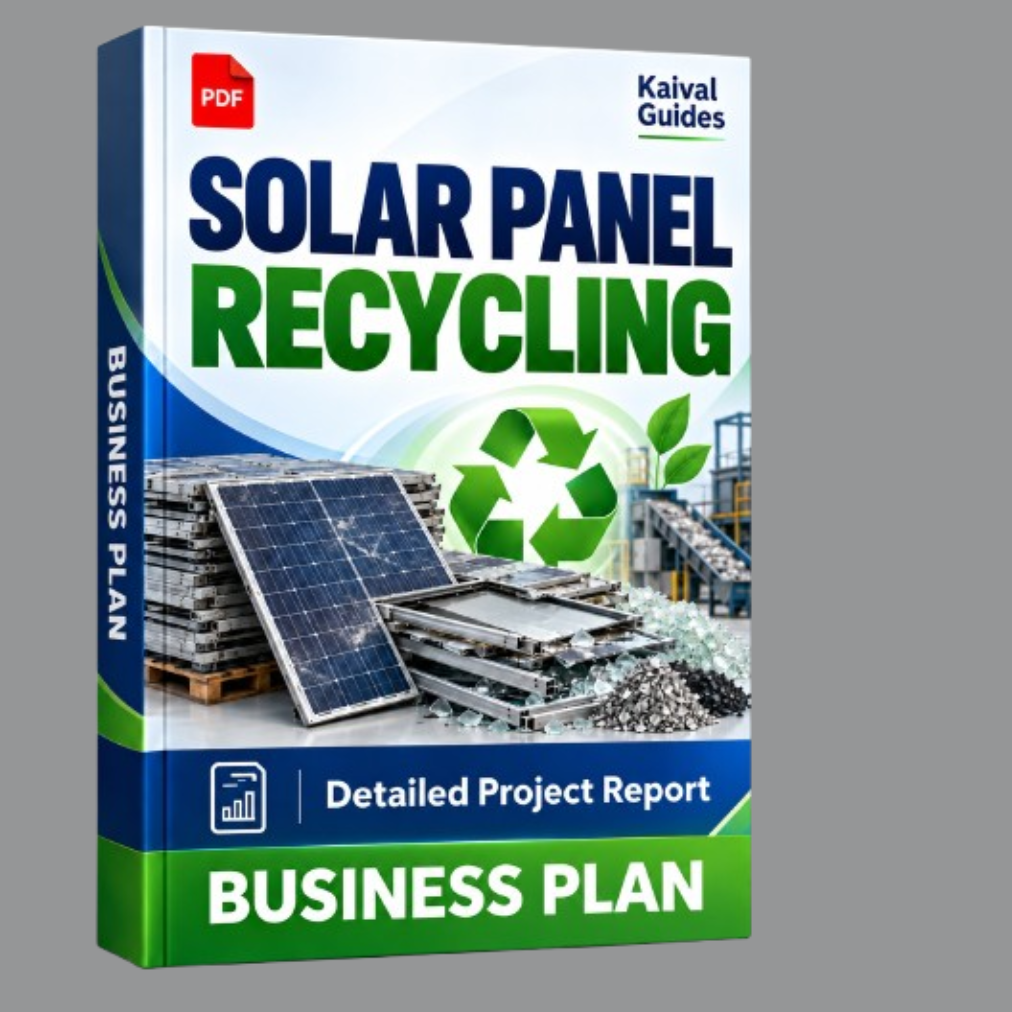
Solar Panel Recycling – India 2026
₹999.00
Explore the business of solar panel recycling in India with this practical 88-page report. Discover entry models, investment planning, sourcing, buyers, financial scenarios, compliance considerations, due-diligence questions, and a 90-day research roadmap—all before committing major capital.
Description
The Solar Opportunity Doesn’t End When a Panel Stops Producing Power.
Who will collect it?
Who will move it?
Who will sort it?
And who will recover its materials?
Explore the business behind these questions—before committing money to equipment, premises or inventory.
Solar Panel Recycling — Detailed Project Report & Business Plan
An 88-page, India-focused digital report covering business entry models, investment planning, sourcing, buyers, financial scenarios and the questions to answer before you invest.
Get the Complete Report for ₹999
GET THE SOLAR RECYCLING REPORT →
Digital PDF · India 2026 Edition · Research cut-off: 24 September 2026
You’ve Seen the Solar Installation Opportunity. Now Explore What Comes After.
Solar panels have a life beyond their first installation.
Some are damaged. Some are replaced. Others eventually reach retirement.
Handling those panels involves more than a recycling machine. It involves collection, transport, sorting, site removal, material recovery and finding suitable buyers.
For an entrepreneur, that raises an important question:
Which part of this business could fit your resources—and what would make it commercially viable?
This report helps you investigate that question in a practical, organised way.
An Emerging Waste Challenge. Several Business Routes to Investigate.
A 2024 MNRE–CEEW study estimated that India’s cumulative solar waste from existing and projected installations could reach approximately 600,000 tonnes by 2030.
That is a national cumulative estimate—not an annual supply figure or waste automatically available to a new business.
The opportunity worth studying is how to connect available waste with the services, infrastructure and buyers needed to handle it.
That starts with understanding where you could participate.
Source: MNRE–CEEW, Enabling a Circular Economy in India’s Solar Industry, March 2024.
A Recycling Plant Is One Option. It Isn’t the Whole Business.
The report compares different entry positions so you can investigate more than factory ownership.
Collection & Reverse Logistics
Explore pickup planning, packing, transport, documentation and service arrangements.
Aggregation & Sorting
Understand how consolidating smaller quantities into organised batches changes storage needs, costs and working capital.
Decommissioning Services
Examine the business considerations behind removing panels from sites and coordinating their onward handling.
Pre-Processing
Explore equipment, infrastructure, partner arrangements and the requirements to investigate before entering.
Full Recycling & Material Recovery
Study plant economics, recovery assumptions, operating costs, capacity utilisation and buyer requirements.
Testing and reuse considerations are also discussed.
Each route brings different responsibilities, capital requirements and commercial risks. The report helps you compare them before choosing what to investigate further.
Before You Ask “How Much Can I Earn?”, Answer These Questions.
Where will the panels come from?
Who controls them—and on what terms can they be collected or purchased?
How much will transport cost?
Who will buy the output, and what quality will they accept?
How much money could remain tied up in stock and unpaid invoices?
What volume would cover monthly expenses?
What happens if purchase prices rise or selling prices fall?
Which permissions and professional checks could apply?
These are the questions that turn an interesting idea into a business decision.
And they are the questions this report is structured around.
What You Get Inside the 88-Page Report
- The Market and Opportunity
Understand the solar-panel lifecycle, potential waste sources, recoverable materials and the difference between national market potential and locally accessible supply.
- Entry-Model Comparison
Compare collection, logistics, aggregation, decommissioning, pre-processing and recycling considerations before deciding where to focus.
- Investment and Facility Planning
Explore indicative equipment, premises, manpower, infrastructure and startup-cost assumptions.
- Supply and Buyer Planning
Learn what to investigate with panel sources, service partners and potential buyers—including volumes, quality, freight and payment terms.
- Financial Models You Can Question
Work through illustrative costs, margins, break-even calculations, 12-month ramp-up models and three-year financial outlooks.
- Downside, Base and Upside Scenarios
See how changing assumptions can change the result, including situations where a model loses money.
- Compliance and Operational Considerations
Review the report’s regulatory roadmap, handling considerations, documentation needs and items requiring local or professional confirmation.
- Practical Decision Tools
Use the founder assessment, location framework, due-diligence questions, worksheets and action tracker to organise your next steps.
One report. A structured starting point for the research your decision needs.
The Value Is in Understanding What Makes the Numbers Work.
A panel can contain recoverable materials and still be expensive to collect and process.
A business can show an operating profit and still struggle to repay debt.
A promising national market can still leave a local operator short of supply.
This report examines those differences.
Its financial sections help you investigate:
- Purchase price versus recovered-material value.
- Transport distance versus margin.
- Plant capacity versus actual throughput.
- Operating break-even versus cash break-even.
- Reported profit versus money available to pay bills.
You see the assumptions behind the figures—so you can replace them with your own evidence.
All financial examples are illustrative, not forecasts or promised returns.
Don’t Stop at Reading. Know What to Check Next.
The report includes:
60 Due-Diligence Questions: A structured set of questions to investigate before committing capital.
Founder Readiness Assessment: Examine your resources, capabilities and preparation.
Location Feasibility Framework: Compare sites using factors that affect operations and costs.
90-Day Research & Launch Roadmap: Organise enquiries, validation and planning. This is a roadmap—not a promise that a facility can be approved or launched within 90 days.
Before Investing Checklist: Review the evidence still needed before making a commitment.
Working Tools and Action Tracker: Print and adapt the included worksheets for your own internal business planning.
Start by comparing entry models. Then use the relevant questions and worksheets to guide conversations with suppliers, buyers and qualified professionals.
Why Spend ₹999 on This Report?
Because an equipment quotation answers only part of the question.
You still need to understand supply, transport, buyers, operating costs, working capital and the conditions under which the model makes sense.
This report brings those subjects together so you can begin that investigation with a clear structure.
₹999 buys you an organised research and planning resource before a much larger business commitment.
It may help you identify a route worth investigating.
It may show that your assumptions need more work.
It may help you decide to wait.
All three can be useful outcomes before money is committed.
Built for People Seriously Exploring the Business
This report is relevant to:
- Aspiring entrepreneurs evaluating solar-panel recycling.
- Existing scrap, recycling or logistics businesses.
- Solar installers, EPC and maintenance businesses exploring adjacent services.
- Business owners comparing service models with plant ownership.
- Investors preparing questions for suppliers, operators or project partners.
You can begin without a technical background. The report includes an orientation section, suggested reading paths and a glossary.
Technical operations, compliance decisions and project execution still require qualified support.
Know Exactly What You Are Buying
Solar Panel Recycling — Detailed Project Report & Business Plan | India 2026
Your purchase includes:
- The complete 88-page digital PDF.
- Business-model comparisons and market research.
- Illustrative investment and financial models.
- Risk, readiness and feasibility frameworks.
- 60 due-diligence questions.
- The 90-day roadmap.
- Included worksheets, checklists and reference sources.
Price: ₹999
This is an educational business-planning report. It is not a personalised consultancy service, supplier introduction service or bank-approved DPR.
GET THE COMPLETE REPORT — ₹999 →
Frequently Asked Questions
Do I need to build a recycling plant to use this report?
No. It covers collection, reverse logistics, aggregation and decommissioning alongside processing and recycling. It helps you compare different entry positions and identify what each requires.
Does it explain investment and profitability?
It includes illustrative startup costs, operating expenses, break-even calculations, financial scenarios and cash-flow planning. These demonstrate how the models work; they do not predict your results.
Will it tell me where panels and buyers come from?
It explains sourcing channels, buyer categories and the questions to investigate with potential commercial partners. It does not guarantee access to panels, suppliers, customers or contracts.
Can I submit this PDF directly to a bank?
No. It is a reference report. A lender-ready proposal needs your project details, current quotations, location-specific assumptions and professional review in the lender’s required format.
Does it guarantee profit, a loan or a subsidy?
No. Business outcomes and approvals depend on your circumstances and the relevant decision-makers.
Is this a printed book?
No. This purchase is for a digital PDF.
How current is the information?
This is the India 2026 edition, with a research cut-off of 24 September 2026. Rules, prices and market conditions can change. The report identifies matters that require further verification.
The Next Step Doesn’t Have to Be a Machine, a Lease or a Deposit.
It can be understanding the business.
Explore where the opportunity sits.
Compare the entry routes.
Examine the numbers.
Know what to verify next.
Start with the Solar Panel Recycling Detailed Project Report & Business Plan.
88 Pages. India-Focused. ₹999.
GET THE REPORT & START YOUR RESEARCH →
Educational and informational resource only. Financial models are illustrative. No income, profit, financing, subsidy, approval or business outcome is guaranteed. Verify current requirements and obtain appropriate professional advice before investing or operating.
Reviews
There are no reviews yet.