
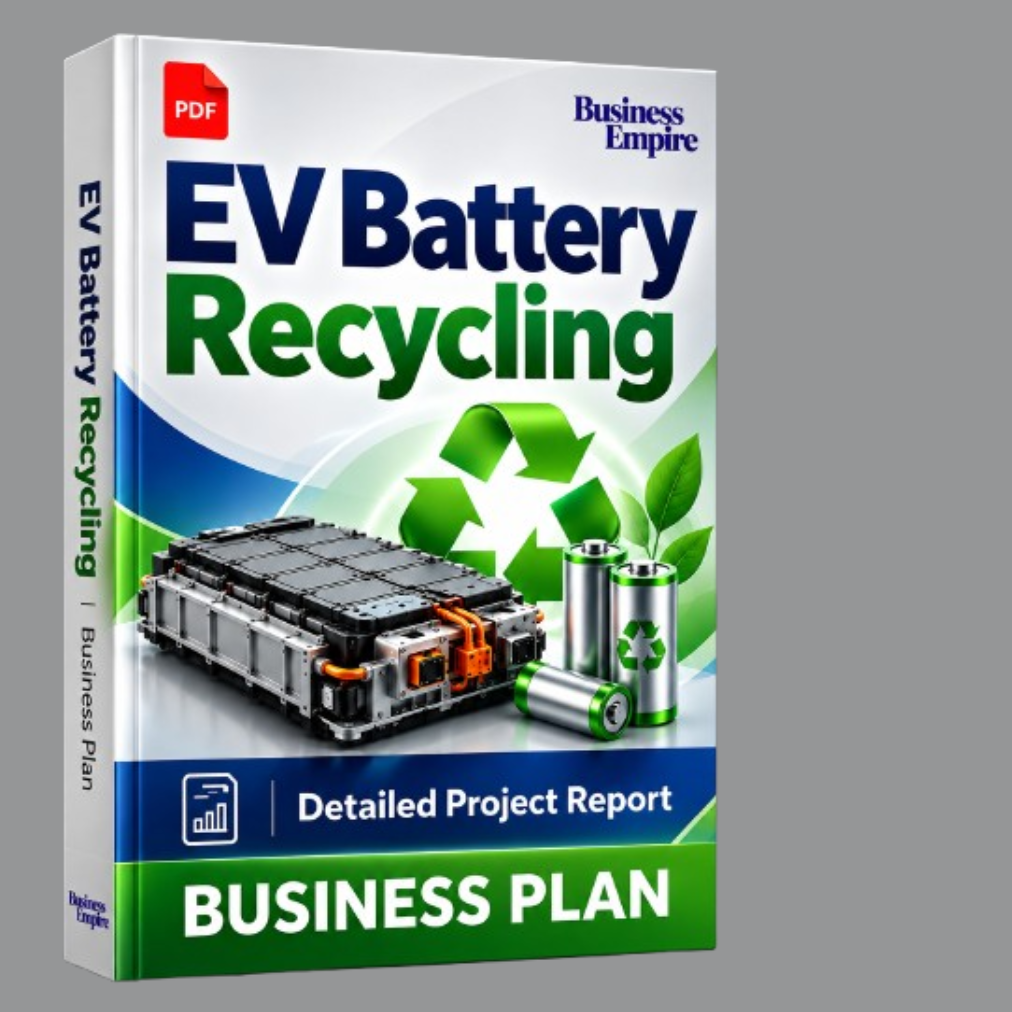
EV Battery Recycling — Detailed Project Report & Business Plan
₹999.00
A practical 88-page digital guide covering EV battery collection, aggregation, B2B supply, recycling, investment planning, financial models, compliance, risk analysis, and business planning for the Indian market.
Description
The EV opportunity does not end when a battery stops powering a vehicle. But where could your business fit into what happens next?
Explore the business of EV battery collection, aggregation and recycling with a structured guide designed to help you research the opportunity before committing your money.
The EV Battery Recycling — Detailed Project Report & Business Plan by The Business Empire brings together market research, business-model comparisons, investment planning, operational considerations, illustrative financial models, compliance guidance and practical planning tools.
Whether you are exploring a collection centre, evaluating an aggregation business or researching a recycling facility, this report helps you identify the questions that matter before moving forward.
88-page digital PDF | 31 main sections | 3 business models | 6 practical appendices
Why Explore the EV Battery Recycling Business?
Understanding this sector means looking beyond the idea of simply buying old batteries and selling recovered materials. There are several parts of the business to investigate:
1. Battery Collection
Explore how used batteries enter the collection network and what supplier relationships, documentation and operational arrangements may be required.
2. Aggregation and B2B Supply
Understand the role of consolidating suitable battery lots, coordinating logistics and supplying registered downstream businesses.
3. Recycling and Material Recovery
Examine the planning considerations behind a processing facility, including technology selection, infrastructure, equipment and buyer requirements.
4. Supply-Chain Partnerships
Learn how to assess potential sourcing relationships with fleet operators, dealers, service networks and other relevant businesses.
5. Battery Chemistry and Material Value
Understand why battery chemistry, condition, recoverable materials and buyer specifications influence commercial decisions.
6. Investment and Working Capital
Explore why machinery cost alone does not represent the total funding required to operate a business.
7. Compliance and Responsible Operations
Identify the regulatory, environmental and safety questions that need verification for your chosen activity.
8. Business Viability
Learn how sourcing volumes, purchase prices, selling prices, operating costs and payment delays can affect the viability of a project.
The report examines these opportunities alongside their risks, helping you approach the sector with a clearer understanding of what must be validated.
What Is Included in This eBook?
1. Industry Overview and Indian Market Research
Build a foundation before choosing your business model.
- Executive overview of the EV battery recycling ecosystem.
- Indian market research and industry trends.
- Battery and recycling terminology.
- Battery chemistry and recycling fundamentals.
- Quick Decision Pages for comparing entry options.
- Key commercial and operational questions for new entrants.
2. Three Business Models Explained
Compare three different entry positions instead of treating every battery-related business as the same operation.
Model A — Collection Centre
Understand collection-centre planning, sourcing relationships, handling considerations and the importance of an appropriate legal and compliance structure.
Model B — Aggregation, Sorting and B2B Supply
Explore procurement, lot aggregation, buyer requirements, logistics, pricing and working-capital considerations.
Model C — Recycling / Material-Recovery Facility
Examine facility planning, process-selection considerations, equipment requirements, technology due diligence and the financial implications of a larger operation.
3. Infrastructure, Equipment and Location Planning
Understand what to investigate before selecting a site or committing to equipment.
- Infrastructure and equipment planning.
- Site-selection considerations.
- Utilities, logistics access and operational requirements.
- Location feasibility factors.
- A weighted location scorecard.
- Comparisons of different site types.
- Vendor and technology verification questions.
4. Procurement, Customers and Marketing
Explore both sides of the business: obtaining suitable feedstock and finding suitable buyers.
- Supply-chain and procurement planning.
- Potential sourcing channels.
- Customer and buyer assessment.
- Commercial terms and payment considerations.
- A marketing plan using the 7Ps framework.
- Supplier and buyer due-diligence questions.
- Meeting guides for recyclers and fleet operators.
5. Operations, Team and Compliance Planning
Identify the systems and responsibilities required to support an organised operation.
- Operations planning.
- Team structure and organisational responsibilities.
- An India-focused legal and compliance roadmap.
- Battery-storage, handling and logistics considerations.
- Documentation and record-keeping requirements to investigate.
- Safety and insurance discussion points.
- Questions to take to environmental and technical professionals.
6. Investment Planning and Illustrative Financial Models
Understand the financial mechanics before relying on a headline profit figure.
- Project-cost and investment planning.
- Funding and financing considerations.
- Three-scenario financial modelling.
- A 12-month illustrative business forecast for Model B.
- A three-year financial outlook.
- Break-even and cash break-even analysis.
- Capacity-utilisation analysis.
- Working-capital calculations.
- The effect of customer credit and delayed payments.
- Sensitivity to changes in buying prices, realisations and other assumptions.
Financial examples are provided to explain planning methods. They are not promises or forecasts of what your business will earn.
7. Risk Analysis and Founder Readiness
Evaluate whether the opportunity matches your resources and capabilities.
- A structured business risk register.
- A risk matrix.
- Feedstock, pricing, buyer and technology risks.
- Working-capital and receivables risks.
- Battery-safety and insurance considerations.
- A Founder Readiness Assessment.
- A framework for identifying preparation gaps.
- A final viability assessment to help organise your decision.
8. A 90-Day Planning Roadmap and Action Checklists
Translate your research into a sequence of practical next steps.
- A 90-day launch-planning roadmap.
- First-year business performance indicators.
- 60 due-diligence questions.
- A pre-investment action checklist.
- Questions to resolve before committing capital.
- A framework for deciding whether to proceed, research further or hold back.
The roadmap is a planning framework, not a promise that a business or facility can obtain approvals and launch within 90 days.
9. Six Practical Appendices
The report includes working templates and discussion guides within the PDF:
Appendix A — Financial Model Worksheet
Organise your own quotations, operating assumptions, funding needs and calculations.
Appendix B — Meeting Guides
Prepare for discussions with registered recyclers, fleet operators, banks and environmental consultants.
Appendix C — Consignment Document Checklist
Identify documentation to discuss and verify for battery movements.
Appendix D — One-Page Business Plan Template
Summarise your entry model, suppliers, buyers, resources, finances and milestones.
Appendix E — Lender-Ready DPR Contents Checklist
Understand the information commonly required when preparing a project-specific report for a lender.
Appendix F — Monthly Management Report Template
Track volumes, prices, profitability, cash, working capital, suppliers, buyers, safety and compliance.
The publication also includes frequently asked questions, a glossary, and source notes and references.
Who Is This Guide For?
- Aspiring entrepreneurs researching the EV battery recycling sector.
- Business owners comparing collection, aggregation and recycling models.
- Professionals preparing for discussions with suppliers, buyers or consultants.
- Entrepreneurs organising information before commissioning a project-specific feasibility study.
- Readers who want to understand investment requirements, financial assumptions and risks before proceeding.
What You Receive
One 88-page English-language digital PDF:
EV Battery Recycling — Detailed Project Report & Business Plan, India 2026 Edition
Published by The Business Empire.
The report contains 31 main sections, Quick Decision Pages, financial illustrations, assessments, checklists and six appendices in a single publication.
This is a digital product. No physical book, equipment or machinery is included. Worksheets and templates are included inside the PDF; separate editable spreadsheets are not included.
Research cut-off stated in the publication: 24 September 2026.
Research Before You Invest
Before choosing equipment, leasing a site or purchasing battery stock, understand the business model, funding requirements, sourcing challenges and questions that need professional verification.
Get the guide and build a more structured foundation for your own research and business planning.
Important Note:
This digital PDF is an educational business-planning reference, not a customised feasibility study or a ready-to-submit bank-loan DPR. Financial examples are illustrative; profits, funding and approvals are not guaranteed. Verify current costs, regulations and local requirements with qualified professionals before investing. Digital download only; no physical book is supplied.
Reviews
There are no reviews yet.